
Explore AML/CTF Reforms
This page is intended for Australian businesses in the following sectors that offer designated services that from 1 July 2026 will become subject to the AML/CTF Amendment Act 2024:
Designated Services
The list of designated services relevant to each sectors is summarised below. Tap each sector to see which designated services apply.
The list of designated services relevant to these sectors is summarised below:
| Item | Description | Accountants | Lawyers | Conveyancers | Trust & Company Service Providers | Real Estate Professionals | Dealers in Precious Metals & Stones |
|---|---|---|---|---|---|---|---|
| 1 | Helping a person with planning or executing a transaction to buy, sell or transfer real estate (including acting on someone’s behalf). | Yes | |||||
| 1 | Brokering the sale, purchase or transfer of real estate on behalf of a customer. | Yes | |||||
| 2 | Assisting in the planning or execution of a transaction to buy, sell or transfer a body corporate or legal arrangement. | Yes | Yes | ||||
| 3 | Receiving, holding, controlling or managing money, accounts, securities, virtual assets or other property as part of assisting in a transaction. | Yes | Yes | ||||
| 4 | Assisting in organising, planning or executing equity or debt financing relating to a body corporate or legal arrangement. | Yes | Yes | ||||
| 5 | Selling or transferring a shelf company. | Yes | Yes | Yes | |||
| 6 | Assisting in the creation or restructuring of a body corporate or legal arrangement (including acting on behalf of a person). | Yes | Yes | Yes | |||
| 7 | Acting as director, secretary, trustee, partner or equivalent role on behalf of a person. | Yes | Yes | Yes | |||
| 8 | Acting as a nominee shareholder of a body corporate or legal arrangement. | Yes | Yes | Yes | |||
| 9 | Providing a registered office or principal place of business address for a body corporate or legal arrangement. | Yes | |||||
| 2: Table 2 | Buying or selling precious metals, stones or products (involving physical currency or virtual assets valued more than $10,000 in total). | Yes |
Our Approach
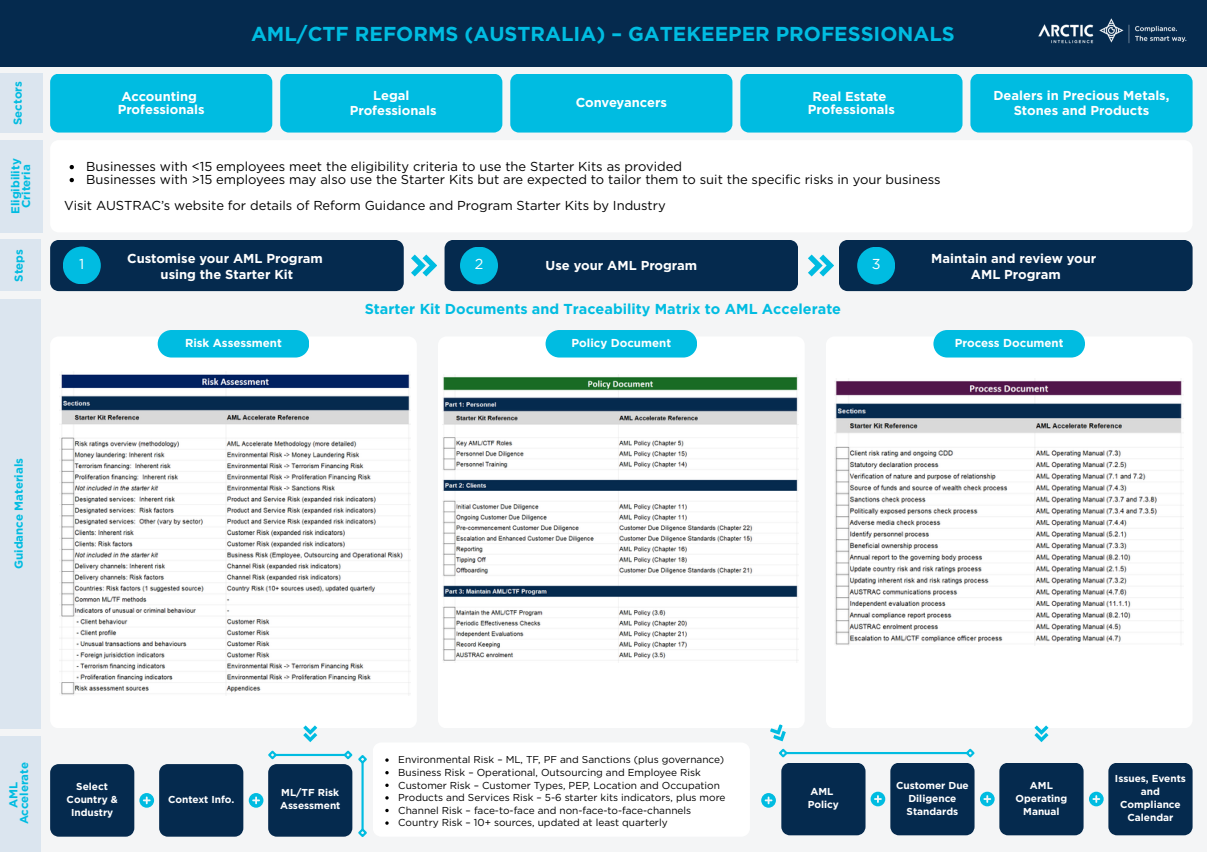
Our subject matter experts have reviewed AUSTRAC’s program starter kit guidance in detail and aligned the main components to the AML Accelerate Platform, which is represented in the traceability matrix below, with a summary of how the platform was updated to align with this guidance and how other components extend beyond this local guidance to align with international best practice.
Getting Started
Creating a new ML/TF risk assessment and AML Policy in AML Accelerate is easy by following these steps:
- Name the AML Policy
- Select Australia from the Country/Region dropdown (noting we support 75+ countries)
- Select the Industry Group and Industry relevant to the account
- Pre-fill from the “Default Template” in future, you’ll be able to “roll forward” from previously created versions
Company Info and Context
AML Accelerate contains a section to document the nature, size and complexity of the business by requesting the following:
- General Registration Information – such as the legal status, legal name, trading name, country and date of incorporation, ABN etc.
- Address Details – such as registered office address and principal place of business address (if different)
- Business Profile Information – such as the nature of the business, the size of the business (i.e., by revenue, customer size, employees) and complexity
- AML Compliance Officer Information – such as their name, role, contact details and their relationship to the Board
- Regulator/Supervisor Information – such as the date of enrolment and registration details etc.
ML/TF Risk Assessment
Whereas AUSTRAC’s starter kit guidance provides specific guidance on customer risk, product and services risk, channel risk and country risk, AML Accelerate covers off these (in more detail than outlined), as well as, considers a range of additional risk indicators, which are summarised below:
| Risk Category | AUSTRAC Starter Kit | AML Accelerate Platform |
|---|---|---|
| Environmental Risk | Considers inherent risk indicators related to money laundering, terrorism and proliferation financing. | Considers inherent risk indicators related to money laundering, terrorism and proliferation financing. AML Accelerate considers other inherent risk indicators such as (a) a business’s exposure to predicate offences (i.e., deceptive, personal and property crimes and illicit trafficking) (b) regulatory compliance risks (i.e., lack of governance and oversight, program alignment to ML/TF risks, program non-compliance and reporting) and (c) targeted financial sanctions. |
| Customer Risk | Considers customer risk indicators such as customer type, PEP status, legal structures creating effective anonymity and unexplained wealth. | AML Accelerate considers these risk indicators, as well as customer location risk and customer industry / occupation risk. |
| Business Risk | The starter kits do not contemplate internal business risk. | AML Accelerate considers geographic footprint, outsourcing and employee risk. |
| Channel Risk | The starter kits consider 5 customer onboarding channels (i.e., in person, email, phone, video conferencing programs and online platforms), as well as customers providing false and/or fraudulent identity information. | AML Accelerate considers a broader set of customer onboarding and transaction channels, including the 5 covered in the starter kits, plus ATMs / IDMs, call centres, fax, remittance platforms, SMS, mobile applications, third-party outlets and use of third-party intermediaries. |
| Product and Service Risk | The starter kits contain 5 or 6 risk indicators for each industry and does not contemplate different risk indicators as they may apply to different designated services. | AML Accelerate considers the same 5 or 6 risk indicators for each designated service and an additional 10 risk indicators per designated service. |
| Country Risk | The starter kits recommend a single source of country risk. | AML Accelerate considers over 10 different sources of country risk and allows users to apply overrides (where rationale for changes must be documented). |
Further, the starter kits do not suggest any controls that could potentially mitigate each of the inherent risk factors, whereas AML Accelerate contains a library of suggested controls, which can be used to test the design and operational effectiveness of these controls, which is used to calculate the residual risk rating both at the risk category level and aggregated across all risk categories and the assessment itself.
Policy Document
In addition, AML Accelerate contains sections for proliferation financing, targeted financial sanctions and regulatory feedback.
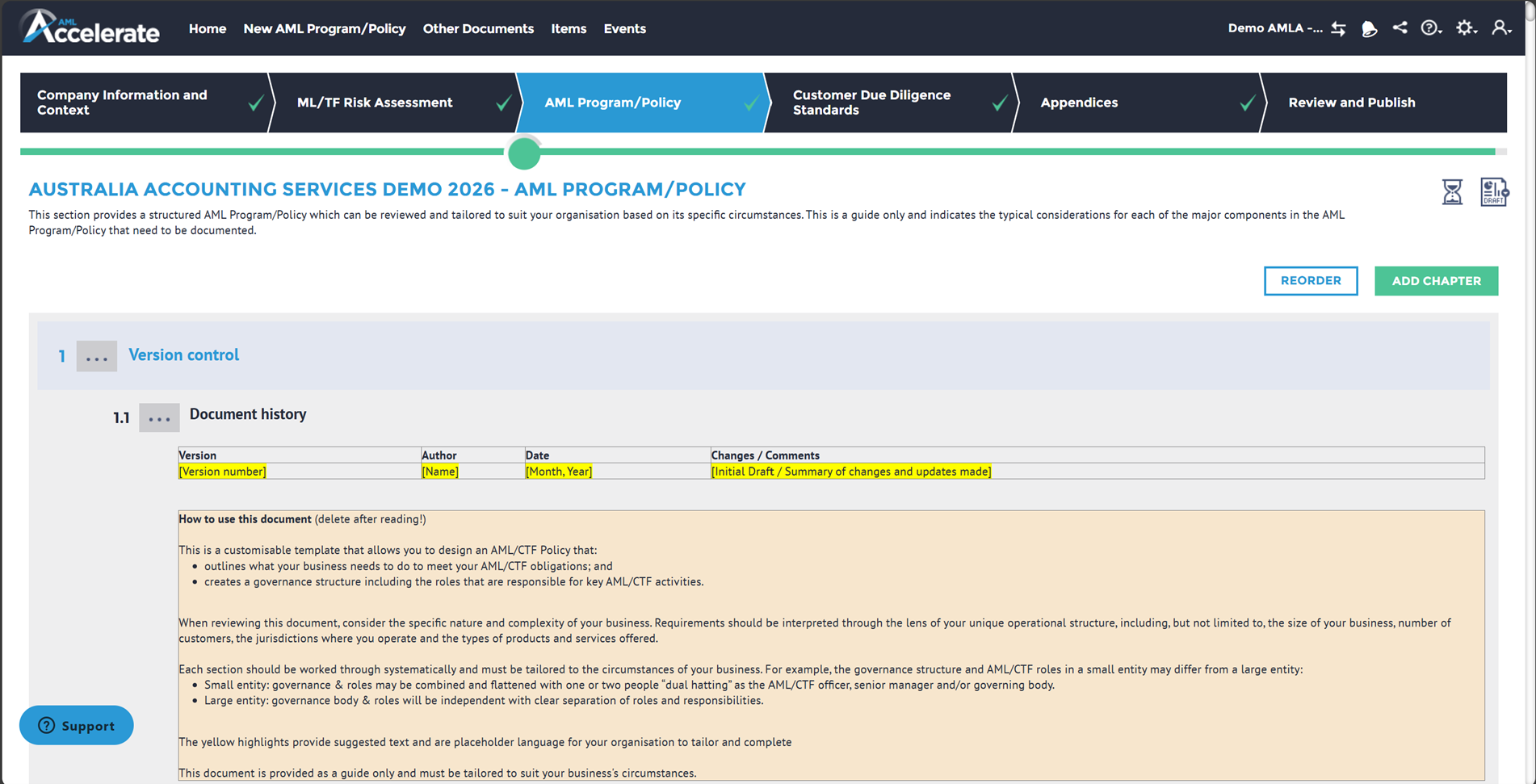
This is an example of how the AML Policy document looks in the AML Accelerate Platform, with all sections fully editable, changeable and publishable:
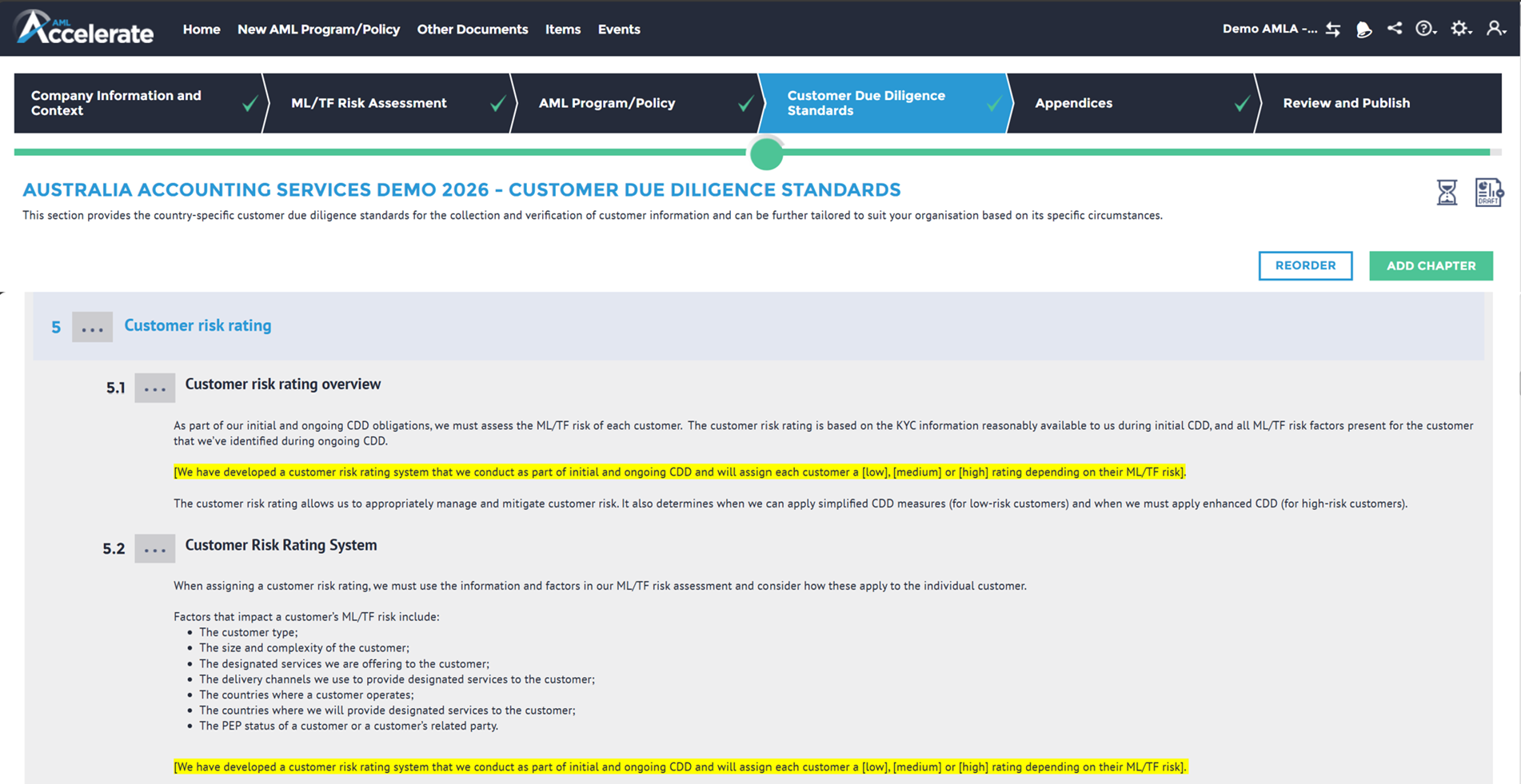
The Customer Identification Verification, Screening and other related requirements of the AML Policy are listed within the Customer Due Diligence Standards section:
Process Document
Swipe to see how the AML Accelerate Platform compares to the AUSTRAC Starter Kit below.
| AUSTRAC Starter Kit | AML Accelerate Platform – AML Operating Manual (Procedures) |
|---|---|
| The starter kits contain guidance on each of the following processes and procedures: | AML Accelerate’s AML Operating Manual covers all of these in more detail, with editable sections and best-practice considerations. |
| Client risk rating and ongoing CDD |
|
| Statutory declaration process |
|
| Verification of the nature and purpose of the relationship |
|
| Source of funds and source of wealth check process |
|
| Sanctions check process |
|
| Politically exposed persons check process |
|
| Adverse media check process |
|
| Identify personnel process |
|
| Beneficial ownership process |
|
| Annual report to the governing body |
|
| Update country risk rating process |
|
| Update inherent risk and risk rating process |
|
| AUSTRAC communication process |
|
| Independent evaluation process |
|
| Annual compliance report process |
|
| AUSTRAC enrolment process |
|
| Escalation to AML/CTF compliance officer process |
|
| There are other sections not included in the starter kit guidance that may be included from an international best practice perspective. | In addition to the operational AML/CTF processes required in the starter kit, AML Accelerate’s AML Operating Manual also contains additional guidance on:
|
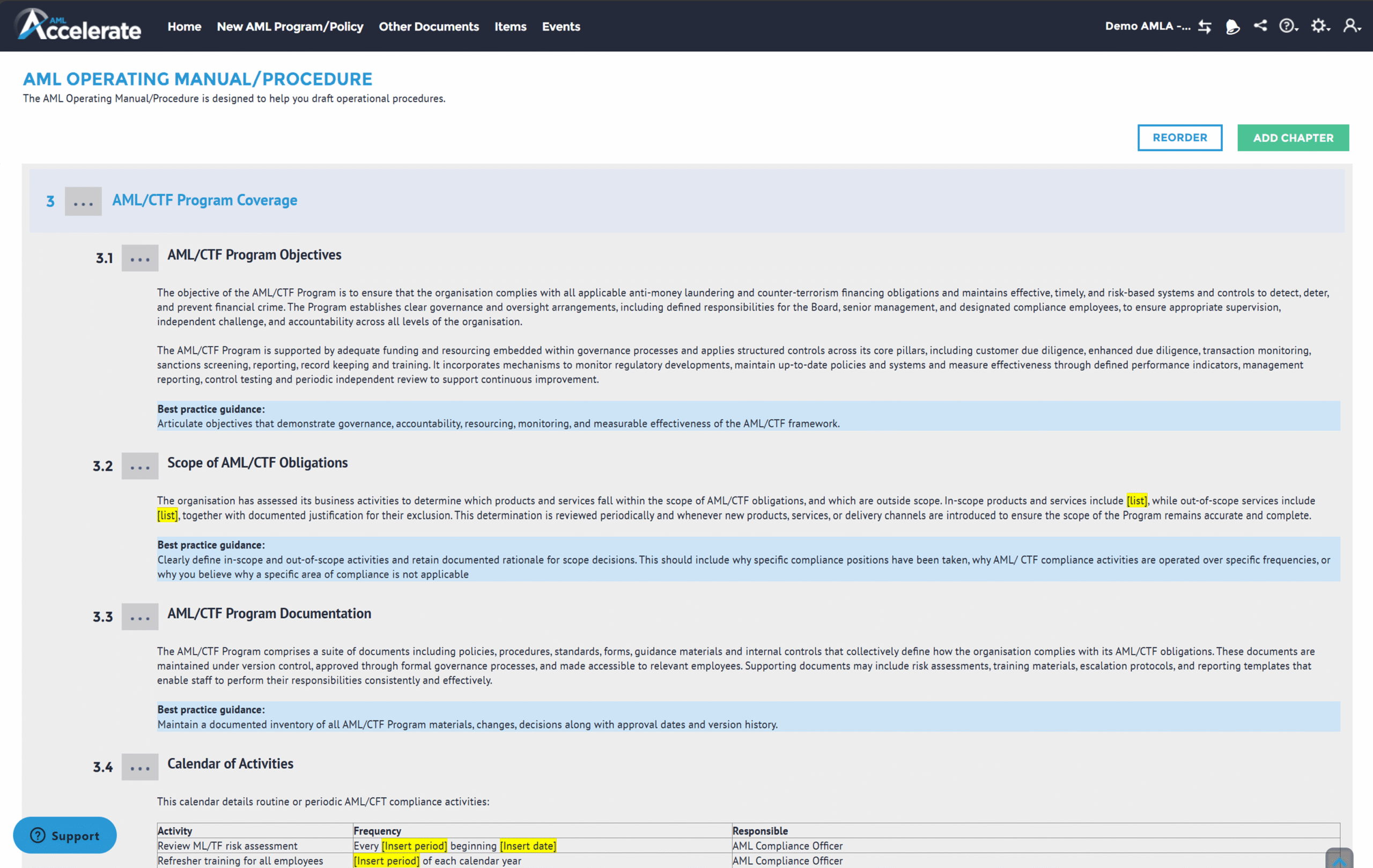
The Policy Document sits as the AML Operating Manual (Procedures) in the platform and describes operational procedures that can be edited, modified or adopted to operationalise the AML Policy and contains best practice guidance for each section (which can be removed before publishing).
Action and Issue Tracking
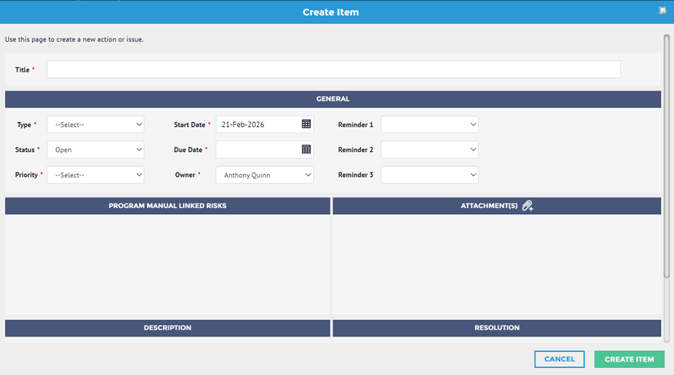
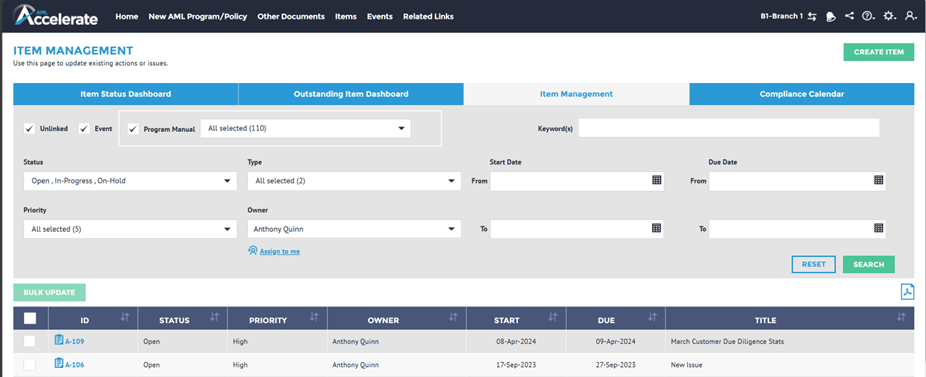
Action and Issue Tracking within AML Accelerate refers to the structured process for recording, monitoring, prioritising and resolving compliance actions, remediation items and identified control gaps. This function ensures that findings arising from risk assessments, audits, assurance reviews, regulatory feedback or internal monitoring are documented, assigned to accountable owners and tracked through to completion. It provides management and governing bodies with visibility over outstanding obligations, remediation progress and systemic weaknesses, supporting defensible governance and demonstrating an active compliance culture.
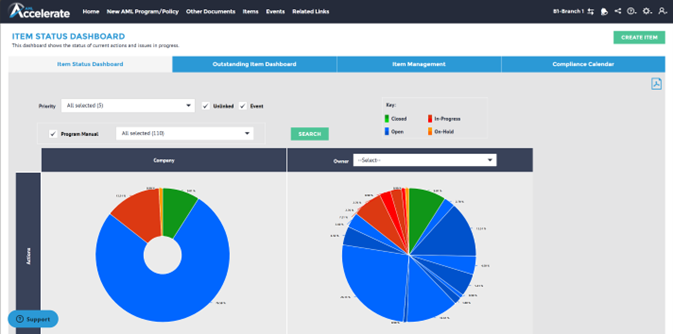
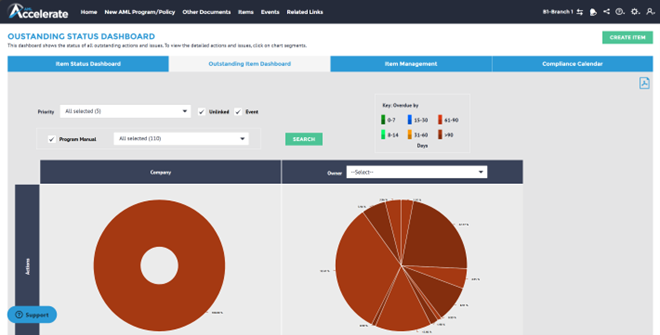
A real-time dashboard provides insights into Actions and Issues by status, owners, target end dates, overdue dates and more.
Breach and Incident Tracking
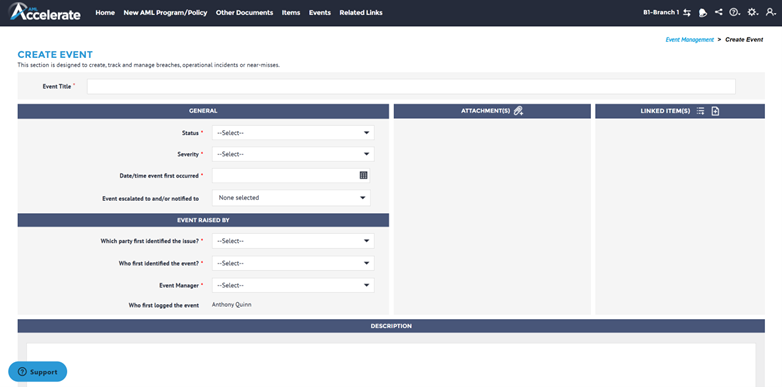
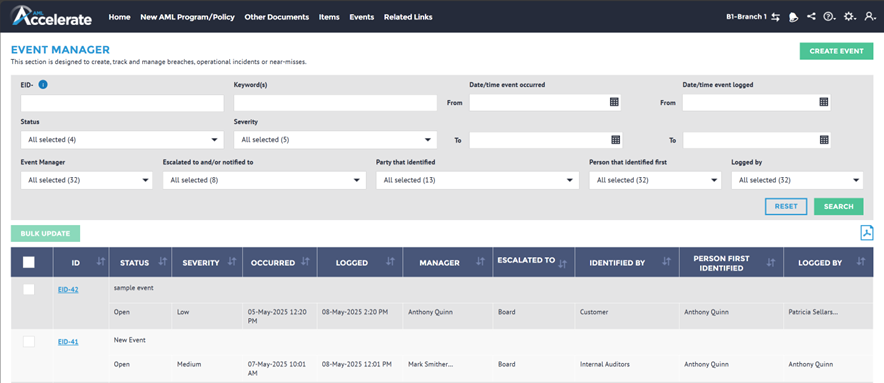
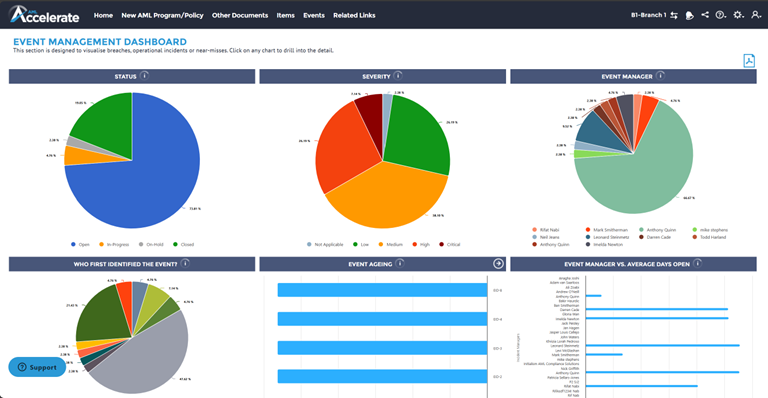
Breach and Incident Tracking is the mechanism used to capture, assess and manage actual or suspected breaches of AML/CTF obligations, control failures or compliance incidents. Within AML Accelerate, this includes documenting the nature of the breach, root cause analysis, regulatory reporting requirements, corrective actions and closure evidence. The purpose is to ensure that incidents are handled consistently, escalated appropriately and remediated effectively, while also enabling trend analysis to identify recurring weaknesses or emerging risk patterns.
Compliance Calendar
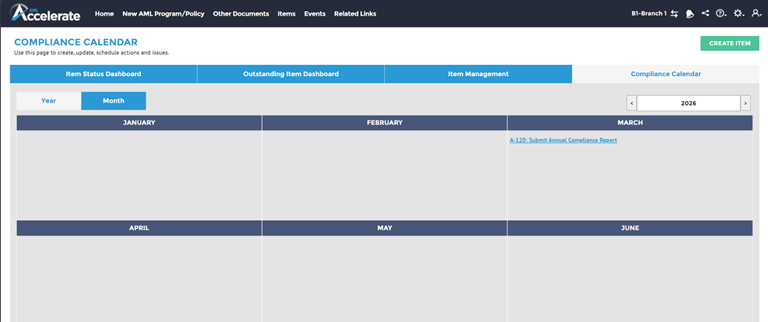
The Compliance Calendar is a centralised scheduling tool that outlines all AML/CTF compliance obligations, key milestones and recurring activities across the program lifecycle. In the AML Accelerate context, this includes regulatory reporting deadlines, risk assessment review cycles, training refreshers, policy reviews, audit schedules and governance reporting dates. By consolidating these obligations into a structured calendar, organisations can demonstrate proactive compliance management, reduce the risk of missed deadlines and support accountability across responsible teams.
Monthly Change Notifications
Monthly Change Notifications refer to periodic updates issued through AML Accelerate that inform users of regulatory developments, typology trends, platform enhancements, methodology refinements or content updates relevant to AML/CTF risk management. These notifications support organisations in staying aligned with evolving regulatory expectations and industry best practice, ensuring that risk frameworks and controls remain current, defensible and responsive to changes in the external risk environment.
Training and Implementation Support
Training and Implementation Support encompasses the onboarding, guidance and capability-building services provided alongside AML Accelerate to ensure effective adoption and operational use of the platform. This includes user training, methodology walkthroughs, implementation planning, configuration assistance and ongoing support. The objective is to ensure that organisations not only deploy the platform but also embed it correctly within their governance, risk and compliance frameworks so outputs are reliable, defensible and regulator-ready.
Considerations for selecting your approach:
AUSTRAC Program Starter Kit vs. Guided Solutions
10 reasons to consider AML Accelerate
1. Time and Cost Efficiency
Starter kits require extensive reading (120+ pages), interpretation, customisation and document drafting, often taking hours, weeks or months. AML Accelerate has starter kit guidance embedded in the platform, with tool tips, call outs and best practice guidance, and is fully editable so you can tailor this to suit your requirements. While manual approaches may appear cheaper initially, they require significant staff time, effort and updates when regulations inevitably change.
2. Guided Workflow
You will be guided through an easy to follow, end-to-end process to produce the required ML/TF risk assessment, AML Policy and AML Procedure output. We’ve incorporated regulatory guidance, international industry best practice and practical experience into AML Accelerate saving you time and money.
3. ML/TF Risk Assessment
Contains a comprehensive enterprise-wide ML/TF risk assessment that also contains suggested controls, which can be mapped against risks and tested (which will be required eventually) and provides a better indication of residual risk, taking into consideration the impact of control design and operational effectiveness on the inherent risks. The ML/TF risk assessment contemplates other risk categories and more risk indicators for each designated service.
4. AML Policy
Contains a comprehensive, yet fully editable AML Policy that incorporates starter kit guidance by industry, which you can easily review, edit and publish. As regulatory developments change, our team updates to a new version, which can be viewed side-by-side, making maintenance of the AML Policy easier.
5. AML Operating Manual
Contains an international best practice procedures manual (i.e., process documents) with practical suggestions for day-to-day operating procedures that can be tailored, adopted and implemented across the business. The content from the starter kit is incorporated, alongside other procedures for you to consider adopting.
6. Regular Updates
As new guidance is released, the changes are reviewed and reflected across the platform and can be copied over and/or compared side-by-side, making maintenance of the AML artefacts easier and less time consuming. We publish a monthly regulatory update, as well as at least quarterly country risk updates.
7. Action, Issue and Event
As you build your AML/CTF Program it is inevitable that you will identify issues, actions and even breaches/near misses or other incidents you want to track and record, which you can do within AML Accelerate, which also produces dashboards and analytics by status, owner and due/overdue date etc. AML Accelerate also contains suggested action plans and controls that could be adopted to strengthen the AML/CTF control framework.
8. Record Keeping
Contains multiple places where supporting documents can be uploaded, stored, retained and retrieved meeting record keeping obligations.
9. Audit readiness
Eventually the ML/TF risk assessment, AML policy and AML procedures, as well as actions taken will be subject to an independent review by a qualified expert, so getting the foundations in place at the start will make this process far less onerous when the time comes.
10. Training and Implementation Support
We take pride in training our customers in our platforms and supporting them so they understand how it works and how they can maintain themselves, but for those that need additional advisory support we also work with a network of advisors that can help you meet your obligations.